
Cross Training for Runners: What It’s For, What It Isn’t, and What Fits London Life
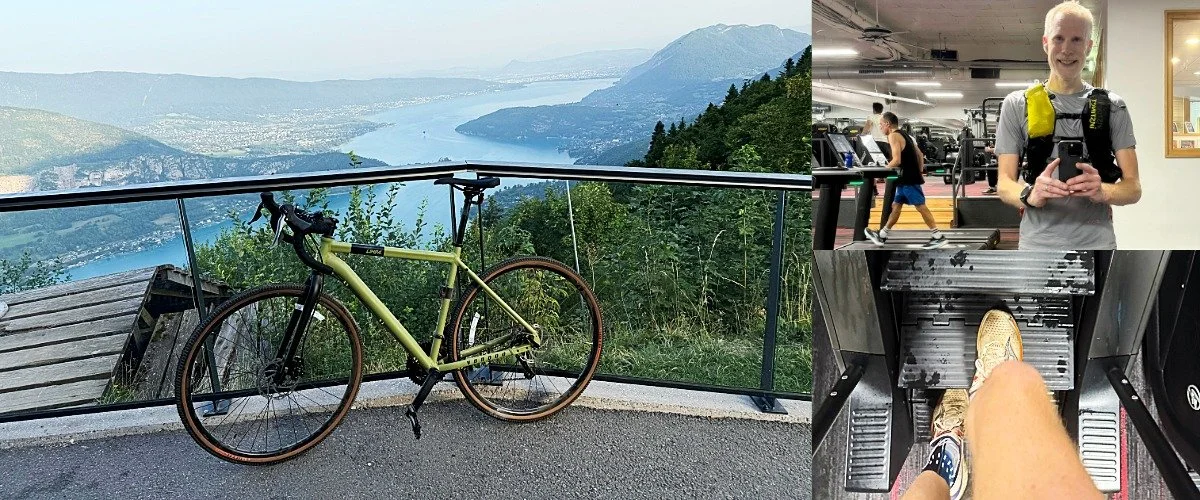
I grew up in Cambridge, so I've always cycled. It's just what you do.
Since becoming a runner, I’ve mostly ridden for one of two reasons.
To add aerobic volume without adding more impact.
Because I couldn’t run as much as I wanted to.
The first meant cycle-commuting through the City and generally trying not to die in traffic. The second has meant many easy hours on the road, taking the stress off my legs generally, and more recently, my ankle in particular.
Sensible decisions, you ask? Sometimes they were. Other times they were little more than making it up as I went along and justifying it afterwards.
In my experience, most runners cross train for one of two reasons.
Someone told them they should.
They’re injured and are trying to replace every missed run with panic-cycling / walking / swimming (insert as appropriate).
Neither tends to result in good decisions.
The first can lead to half-hearted gym bike sessions that don’t really do much.
The second to thrashing around on Zwift for a couple of hours three times a week until the physio finally says you can run again.
At which point the cross training disappears overnight.
There’s a better way to think about this. Cross training works, but it works in proportion to how clearly you’ve decided what you’re using it for.
Get the “why” right and the “what” mostly answers itself.
By the way, this is a piece about cardiovascular cross training. Strength training is a separate pillar, and I’ve written about it here.
That’s its own conversation.
What I mean by cross training.
For this blog, let’s call cross training non-running aerobic work that contributes to your running fitness, recovery, or resilience*
Cycling, swimming, elliptical, that sort of thing. That definition deliberately excludes a few things.
As mentioned, strength training is its own thing. Mobility and yoga work matter, but they sit in a different category. They’re more about movement quality and recovery than aerobic stimulus.
And walking the dog is lovely, but, unless it’s a VERY energetic dog, it’s not cross training.
*Note: The point of the definition isn’t to be precious about labels. It’s that “cross training” gets used so loosely that it stops meaning anything. If we’re going to make decisions, we need to know what we’re making decisions about.
The science: what cross training can and can’t do.
The honest summary is that cross training transfers well at the centre, but poorly at the edges.
What transfers well is the cardiovascular machinery. The adaptations that make your heart pump more blood per beat, your blood carry more oxygen, your muscles use it more efficiently - these are largely modality-agnostic.
Aerobic fitness built on a bike or in a pool is real aerobic fitness. A well-trained cyclist and runner with similar aerobic capacity share much of the same central engine, even if the performance expression looks very different.
What transfers less well is everything specific to running.
The neuromuscular patterns. The tendon and bone loading. The eccentric strength required for a long downhill. The accumulated time-on-feet that lets you keep moving in the 20th hour of a hundred-miler.
A cyclist is not a runner because the chassis is different.
The headline limitation, then, is specificity. For runners, there is no substitute for running.
Cross training supplements running.
It does not replace it, except when it has to.
And the more specific the demands of the race become, the more specific the useful cross training becomes too.
One practical limitation, particularly for busy runners, is time efficiency. Running is brutally efficient. You can create a large aerobic stimulus relatively quickly.
Most non-impact modalities require more time to create a comparable training stimulus, which matters when training already has to fit around work, commuting, childcare, and trying to be a vaguely functioning adult.
Hold onto all this, because it sets up everything that follows.

Reasons you might cross train.
Four reasons worth taking seriously. The first is the one most London ultra runners probably need most.
Adding aerobic volume without adding running load.
Your aerobic system can usually absorb more work than your tissues can, particularly when you’re already running five or six times a week.Cross training lets you bank extra aerobic stimulus without the same impact cost.
For time-poor runners, this can be surprisingly useful. An easy ride on the turbo while the kids are asleep. Forty minutes on the gym bike after strength work. Commuting by bike instead of the Tube once or twice a week.
It doesn’t need to look like a professional cyclist’s training camp to count. Ninety easy minutes on the bike adds meaningful aerobic work at a fraction of the recovery cost of another ninety-minute easy run.
Maintaining fitness through injury
When running isn’t possible, or is being rationed, cross training stops being optional.
This is where the central transfer matters most. You can hold onto a large amount of cardiovascular fitness through a multi-week interruption to running if you replace the volume with something else.
One nuance worth knowing: it’s intensity that protects your top-end fitness, not volume alone.
Hours of easy spinning will hold your aerobic base remarkably well, but VO₂ max and high-end aerobic power tend to drift down if all the work becomes easy.
If the injury allows, keeping some moderate or harder efforts in the cross training often helps preserve more fitness than simply adding more volume.
I know this from personal experience. The key is understanding that the goal has changed. You are no longer trying to become a better runner directly.
You are trying to avoid detraining while giving tissues space to settle. That distinction matters psychologically as much as physiologically.
Recovery and circulation between hard sessions
Easy spinning the day after a threshold session. Easy swimming after a long run.
The aerobic cost is real but relatively small. The point is gentle circulation through tired tissues, not smashing out another training stimulus.
Lower stakes, but useful. Particularly for runners who spend most of the day sitting at a desk before trying to train hard at 7pm.
Building for the specifics of your ultra
This one becomes more relevant as races get longer and stranger.
Time on feet under load. Different recruitment patterns. The ability to keep moving when the running legs are fading.
For Spine-style events, where you may spend hours walking with a heavy pack, training for this matters more than people sometimes realise, and the stair stepper becomes very specific training.
For Lakeland-style races, where technical descending and running economy matter more, the balance shifts back toward running specificity.
What you do depends on what you’re trying to train. Understand the demands of your race before you pick a modality.

The modalities: pros, cons, and what they’re actually good for.
Here’s five worth knowing about.
Cycling: Probably the best option for adding aerobic volume. Low impact, scalable, relatively easy to recover from.
For most runners, an hour of easy cycling is usually a smaller training stimulus than an hour of running, which is why bike-based cross training often works best as a volume play rather than a direct substitute.
The other practical limitation is time. Riding enough to meaningfully replace running takes a while.
That said, cycling fits surprisingly well into London life if you let it. Indoor trainers remove the weather variable entirely. Commuting by bike quietly adds volume without needing another training slot. Gravel riding at the weekend scratches some of the same psychological itch as trail running.
One physiology note worth knowing: heart rate tends to sit roughly ten to fifteen beats lower on the bike than when running at a similar perceived effort.
If you use running heart rate zones for cycling, you’ll often end up working harder than intended.
Swimming: Strong full-body conditioning. Excellent for recovery. Near-zero impact.
The catch is technique. For most adult-onset swimmers, the technical ceiling on intensity is relatively low, and the limiting factor becomes shoulders and coordination long before the aerobic system is maximally stressed.
That’s fine if recovery is the goal. Less ideal if your main aim is maintaining high-end aerobic fitness.
Swimming also has a hidden logistical cost for busy adults. Pools have opening times. You need kit. You need to get there. You need to not forget your goggles.
Sometimes the friction matters as much as the physiology.
Deep water running: The closest biomechanical analogue to running you can get without running.
Tethered or untethered, in a pool deep enough to keep your feet off the bottom, mimicking the running gait. The evidence for maintaining running fitness through injury is genuinely strong.
It is also, to be clear, dull. You will feel ridiculous for the first three sessions.
Worth it anyway.
If you're injured and trying to hold onto running fitness specifically, this is the option most runners overlook. Most probably shouldn't.
Elliptical and Arc trainer: Gym-accessible, low impact, decent aerobic stimulus.
Useful for offloading the lower limbs without losing the rhythm of a continuous effort.
The honest limitation, which I ran into during my ankle rehab, is that the machine often caps your cadence, which makes it difficult to push your heart rate particularly high if you’re already reasonably fit.
You end up sitting in the equivalent of zone 2 regardless of how hard you try to force it.
Still useful as part of the mix. Harder to use as the only option.
The upside is convenience. For busy runners, convenience matters more than people sometimes admit.
A modality you can fit into your Tuesday evening is infinitely more useful than the theoretically perfect session you never manage to start.
Stair stepper: Strong specificity for long climbs and pack-loaded efforts.
The reason I built up long stair stepper sessions in the lead-up to the Winter Spine was that the demands of the race, with hours of hiking with a pack, mapped onto the stepper better than anything else realistically available to me in Richmond.
The trade-off (and benefit) is high local fatigue. It’s easy to overdo. And it’s very event-specific.
I’ll did less (well none) of it for Lakeland 100, because Lakeland rewards a different blend of movement economy, descending resilience, and technical running.
Hiking deserves a mention too. For marathon runners it sits somewhere between training and life.
For many mountain ultra runners, hiking is simply part of the sport and deserves to be treated as such.

What this looked like in practice.
Two examples: my ankle and my Lakeland build.
When I was managing my spring ligament issue last year, running was either off the table or sharply rationed for weeks at a time.
The cross training had a very clear job: hold aerobic fitness while the ankle settled.
I cycled about four and a half hours a week, mostly road and gravel, mostly outside, almost all of it easy. I added about three hours of arc trainer to fill the volume on days where weather, darkness, or life made riding awkward.
The cycling worked. The arc trainer worked, with the caveat above about heart rate ceiling.
What I should probably have done differently with hindsight is more deep water running and less arc trainer, because the specificity was better and the heart rate ceiling wasn’t the same issue. But equally I’m not sure I could face it.
For the Lakeland build now, the picture is different.
Running is the main course. Cross training is the seasoning. I’m riding easy for additional aerobic volume on days where another run would probably push the load slightly too far.
Same modality. Completely different purpose.
The “why” changed, so the “what” changed too.
Enjoyment is the tiebreaker, not the starting point.
The standard line is that the best cross training is the one you enjoy.
It’s true, and it’s also incomplete.
Enjoyment matters because adherence matters. If you hate it, you probably won’t do it, and a session you never actually start is physiologically useless no matter how good it looked on paper.
But enjoyment is what you use to choose between modalities that serve the same purpose. It’s not a substitute for understanding the purpose in the first place.
If you need to maintain fitness through injury, deep water running and cycling can both work, and you pick the one you’ll show up to.
If you’re preparing for a Spine-style event, your enjoyment of swimming is probably less relevant than whether you need more time moving uphill under load.
That’s the framework. Decide what you’re cross training for. Then let enjoyment break the tie.
In summary…
Working out what fits your race.
Cross training won't replace running. Nothing replaces running, for running.
But used with a clear purpose, it can add aerobic volume you couldn't otherwise absorb, hold fitness when you can't run, ease tired legs between hard sessions, and prepare your body for the specific demands of the race in front of you.
Used without a clear purpose, it's just extra exercise in an already busy week.
Decide what you're cross training for first. The rest mostly takes care of itself.