The Spine Race: What Actually Matters
I’d like to share what I learned on the Pennine Way…
To spare you learning them yourself, the hard way.
There’s no shortage of Spine Race blogs. Most of them focus on the struggle. And while that’s understandable, unless you know the author, it’s rarely that interesting.
Don’t get me wrong, the Spine is hard. The Proclaimers must have really loved someone to walk 500 miles, let alone 500 more. In the end, 268 was more than enough for me.
Before my race, what I really wanted wasn’t reassurance that it would hurt. I already knew that. What I wanted was insight into what actually helps when you’re cold, tired, and a long way from the finish.
Actual practical guidance on what to do rather than descriptions of suffering… and praise for the volunteers. Although they really are great.
There’s already some excellent information out there on kit and preparation. James Elson at Centurion Running has put together helpful resources on Spine kit and broader race considerations >
This blog isn’t an attempt to repeat that. This isn’t a race report either.
It’s a collection of things I learned from the race.
Small decisions. Mundane ones. The sort that don’t sound dramatic, but ones that help you keep moving forward, rather than quietly unravelling.
If you’re doing the Spine for the first time and you’ve already read the basics, this is the stuff I think matters just as much as passing kit check.
I won’t be offended if you don’t read it cover to cover. Dip into the various as and when you need them. And If you’re short on time, skip to the summary at the end.
1. ‘Expecting to Fly’: Knowing what to expect reduces the mental load
It’s not just the terrain itself that wears you down…
Although the bogs and ice really do. It’s also the mismatch between expectations and reality.
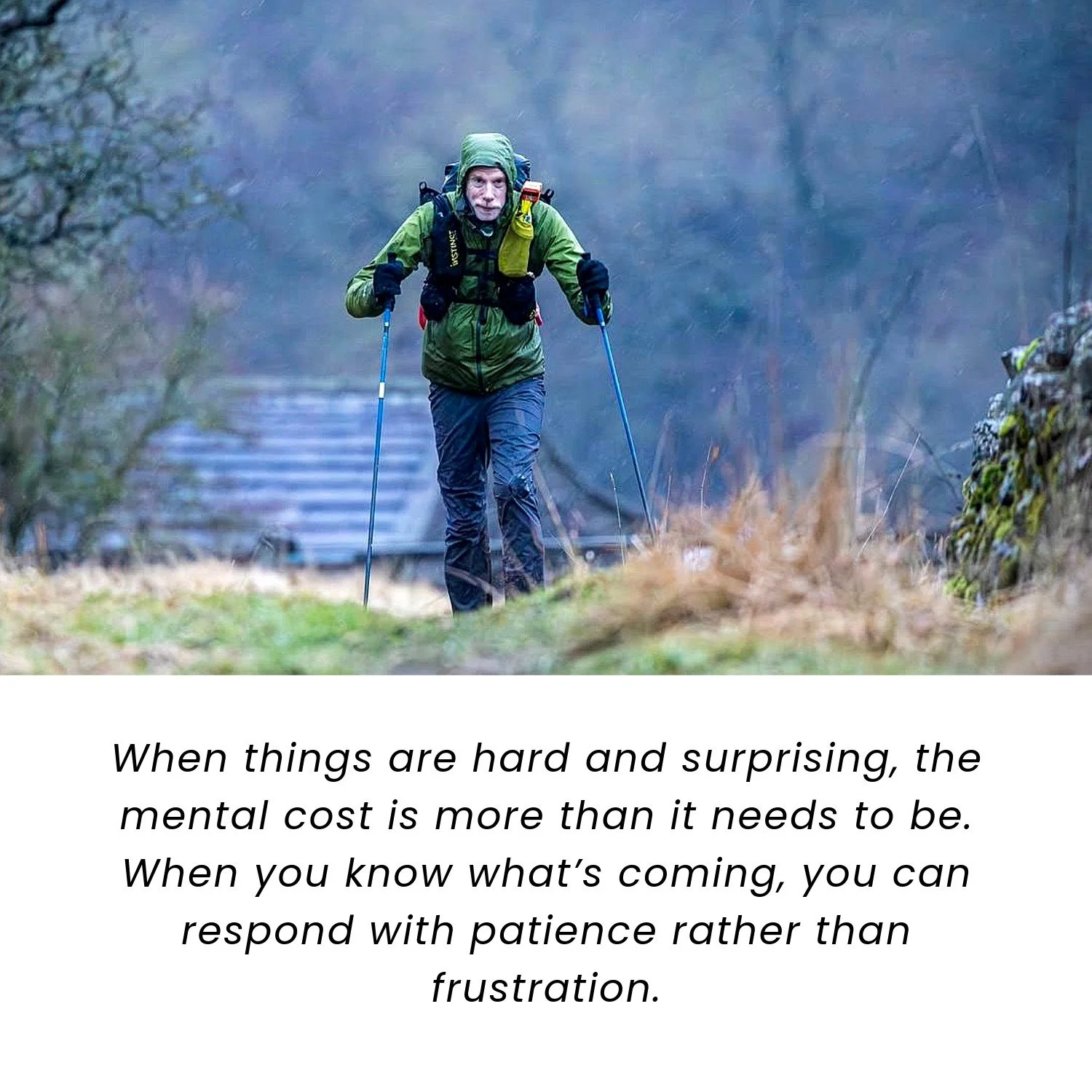
When things are hard and surprising, they mentally cost more than they need to. When you know what’s coming, you can respond with patience rather than frustration.
At a high level, here’s what I feel is worth knowing.
Sections that are genuinely runnable…
Make hay while the sun (it usually doesn’t) shine. There are long stretches of the Spine where steady, easy running is possible:
Cam High Road
Cauldron Snout to High Cup Nick
High Cup Nick to Dufton
Cross Fell to Garrigill
The forestry roads heading towards Byrness
The Cheviot slabs (when they’re not covered in ice)
Knowing this matters. Moving well through these sections gives you momentum, confidence, and a sense of progress. That pays dividends later, when progress slows to a crawl.
Sections that are just unpleasant…
For a variety of different reasons:
Sleightholme Moor: bog, including the occasional shoulder-deep hole
Blenkinsopp Common: more bog
The Falcon Clints: a talus field you have to clamber over, in the dark if your timing’s unlucky
Middleton-in-Teesdale to Langdon Beck: not hard, just relentlessly boring, especially when you’re already thinking about the Teesdale Tandoori
The Cheviots: because you’re moving very slowly, and icy slabs make everything harder than it needs to be
They’re not all grim in the same way. Some sap energy. Some sap patience. Some do both. Knowing these sections feel bad helps you deal with them calmly rather than emotionally.
You don’t waste energy fighting the experience or wondering what you’re doing wrong. The course doesn’t change.
But how surprised you are by it can make a huge difference.
2. ‘Food and Art’: What I planned vs what I actually ate
I went in with a sensible plan.
A mix of real food and gels. Sweet and savoury. Soft and crisp. Broad calorie targets, with backup options if things stopped working.
I’d felt I’d bought far too much, so I pared it right back. Then decided I didn’t have enough and packed more. Eventually I came home with loads.
That, in itself, is probably normal.
What I actually did…
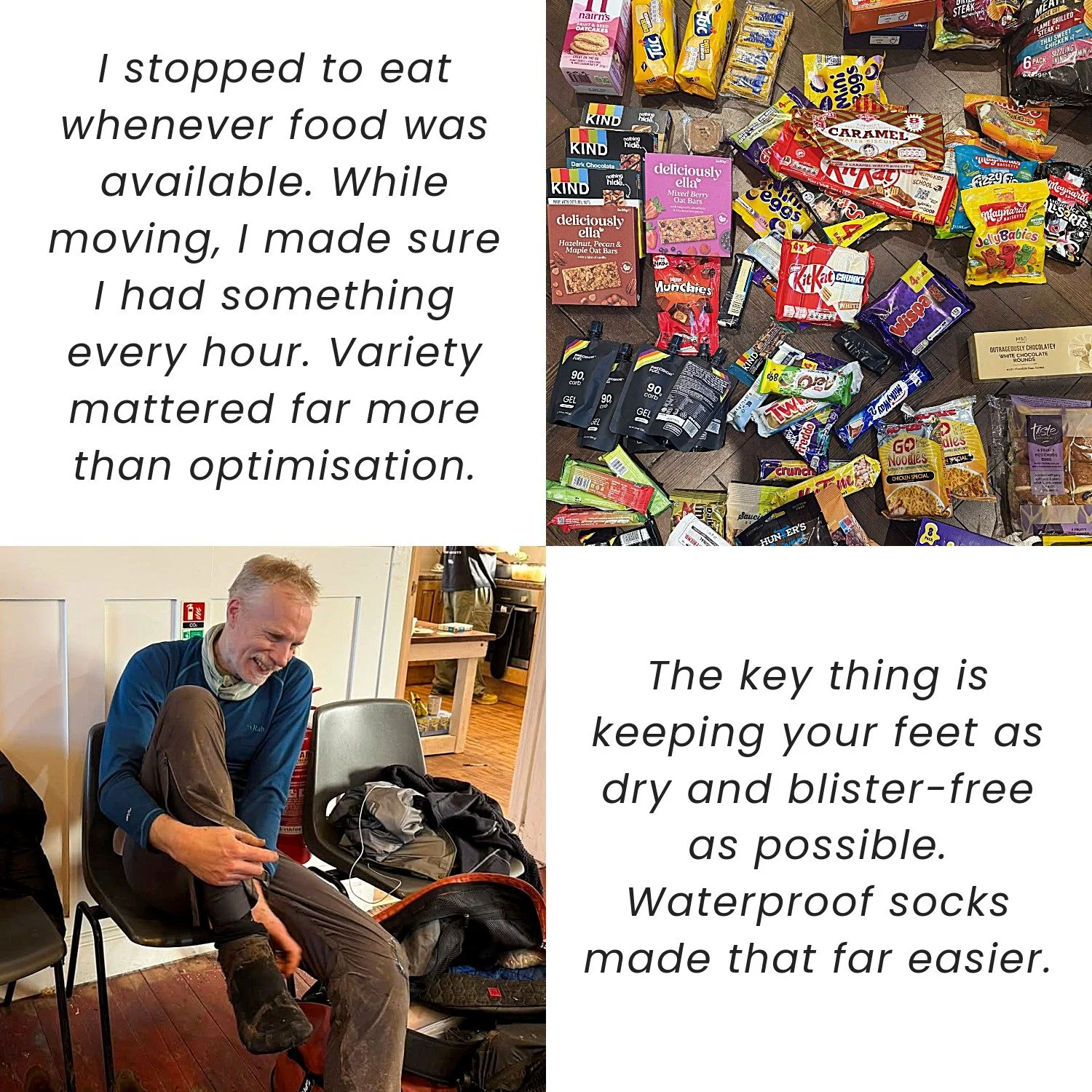
I stopped to eat whenever food was available. That meant places like Snoopy’s at Wessenden Head, Nicky’s by the M62, the Gargrave Co-op, Malham, the Post Box Pantry in Dufton, Annie’s in Garrigill, and Horneystead Farm.
These places are part of Spine-lore. Take the time to soak them up unless you’re in a real hurry
At aid stations, I ate properly. Not a snack. At least two or three portions each time. The curry at Langdon Beck and the lasagne at Alston really are as good as people say.
While moving, I made sure I had something to eat roughly at least every hour.
Variety turned out to be far more important than optimisation. Between Hadrian’s Wall and Bellingham, the only thing I could eat was crisps. Not because they were optimal but because everything else felt gross.
That was fine. The Spine rewards consistency and adaptability far more than perfect fuelling plans.
3. ‘Feets Don’t Fail Me Now’: Boring, dry, and mostly fine. Which was the point
I wasn’t a big DexShell fan before I started training for the Spine.
Post-race, I’m a believer.
I paired waterproof socks with Injinji liners and my feet stayed dry throughout. I finished with two blisters, one of which appeared on the run into Kirk Yetholm.
That’s not exciting. But it matters. Macerated feet or blistering can be race-ending.
It all worked well enough that I got away with a couple of rookie errors: forgetting talc and not trimming my toenails.
As an aside, while knee-length waterproof socks are the better option, the calf-length versions work perfectly well too. The key thing is keeping your feet as dry and blister-free as possible, not chasing a perfect setup.
Finally, pack a half-size or full-size larger pair of shoes. My feet got progressively more swollen as the race went on.
4. ‘Living on the Edge’: The art of layering
Make no mistake, the Pennine Way in winter is cold.
And depending on the size of your warm layer, one jacket may not be enough. There were times when I was carrying two down jackets - one on and one in my pack.
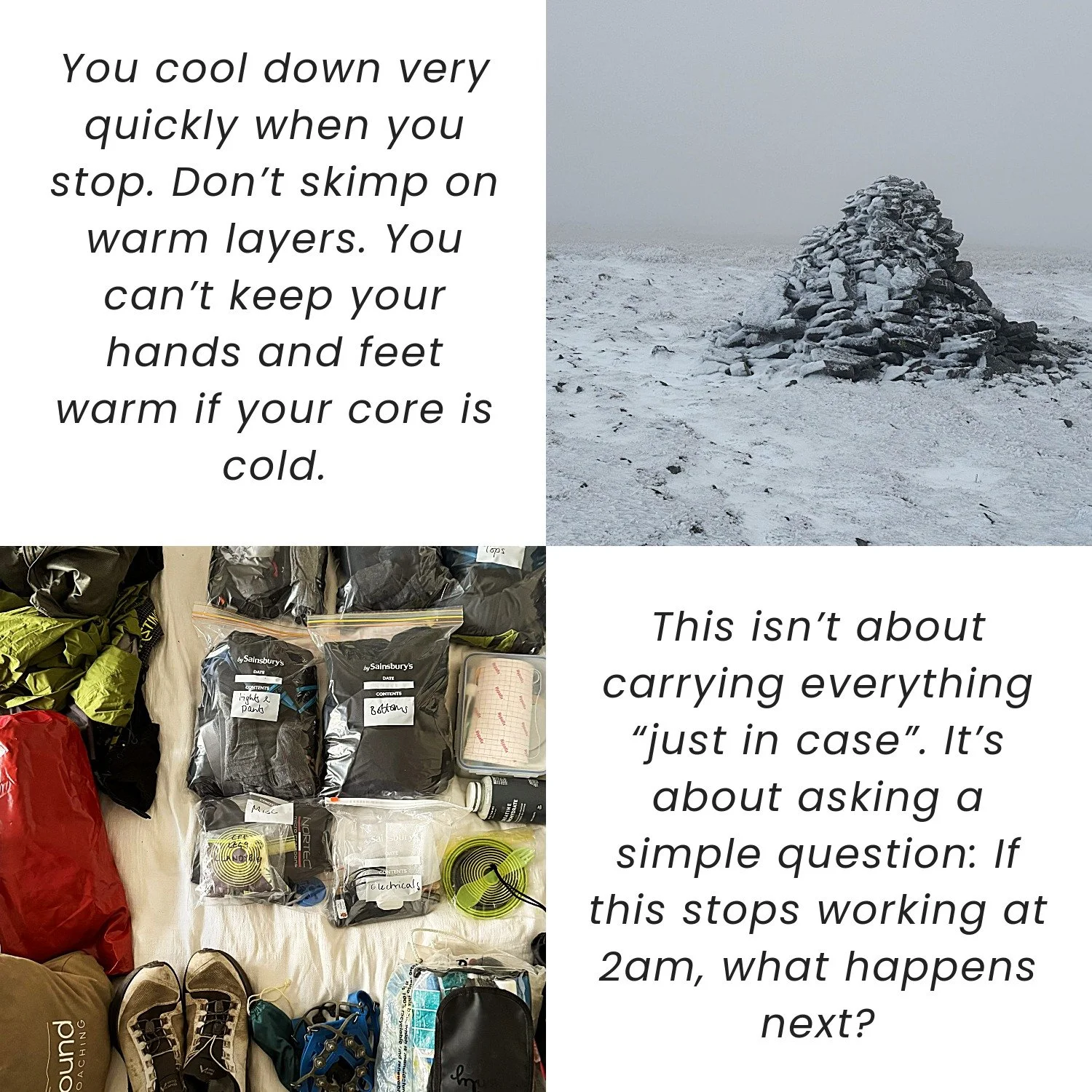
You cool down very quickly when you stop, and I got properly cold sitting in Hut 1 with a cup of tea. Don’t skimp on warm layers.
A cycling base layer is also a great extra layer to have. They’re light, packable, and easy to wear under your normal kit when you need a bit more warmth without bulk.
Just as important is learning to regulate your temperature incrementally. If you feel slightly cold or slightly warm, make a small adjustment:
put a hat on or take one off
pull up a hood
add or remove gloves
undo or close a zip
If you need to warm up properly, add insulation to your core. You won’t keep your hands and feet warm if your core is cold.
Being a little cold isn’t always a problem. At times, particularly over the Cheviots, I deliberately kept myself slightly cool to stay alert. Not dangerously so, just enough to avoid that heavy, sleepy feeling.
What doesn’t work is waiting until you’re properly cold before doing anything about it. Warming back up takes time and energy, and in the worst cases it can end your race. A number of leaders dropped out with hypothermia this year.
As they say in the race briefing: be bothered.
5. ‘Spare Parts’: Always have them
Before the race, my Garmin and my headtorch were both a bit flaky.
The Garmin would sometimes refuse to charge. The headtorch occasionally took a few attempts to turn on. Neither actually failed during the race. But they easily could have.
That uncertainty was useful. It forced me to think properly about single points of failure.
The kit list says headtorch plus spare battery, but that assumes the torch itself works. If it doesn’t, the spare battery is irrelevant.
So I made sure I had replacements for anything genuinely critical. Not because I expected failure, but because I wanted a plan if it happened.
This isn’t about carrying everything “just in case”. It’s about asking a simple question:
If this stops working at 2am, what happens next?
If the answer is “panic, improvise, or hope”, that’s a problem.
If the answer is “I already know what I’ll do”, you stay calm and keep moving.
In the end, I didn’t need the spares. But knowing they were there removed a layer of background stress and made decision-making easier when I was tired.
The Spine doesn’t usually end because one thing goes wrong - it ends when a small problem turns into a big one because you weren’t ready for it.
6. ‘Chunks’: Breaking up the race (and distracting your brain)
Races like the Spine are simply too big to hold in your head. If you think about the whole distance, you’ll overwhelm yourself very quickly.
I never thought about “the finish” in any meaningful way. I thought about the next thing in front of me: the next café, the next checkpoint, the next small task once I got there.
Wobbles are inevitable. In the Cheviots everything felt slow. The slabs were heavily iced. I was tired. Decisions took more effort. Progress felt minimal, even when I was moving.
I found myself obsessively checking my watch, the map, and the tracker, looking for reassurance that I was still going in the right direction.
Distraction helped: podcasts, audiobooks, music. At one point I think I listened to the same playlist for 36 hours. Repetition helped. Accepting boredom helped.
This isn’t a motivational problem - you don’t need inspiring thoughts. You need ways to stop your brain catastrophising when progress feels slow. The race doesn’t need conquering but it’s the next step that needs completing.
Injuries are a case in point.
Early on I strained my tib ante. The bog and ice didn’t help. On the Cam High Road my right ankle hurt with every step, and I started catastrophising. Cue a slightly panicked phone call to Sally.
I made it to Hawes, where the medic suggested something very sensible: a shower and some sleep. That alone reset things more than any analysis could.
Even so, when I woke up I could barely walk downstairs and was convinced there was no way I could run again. But after some food, a bit of movement, and about fifteen minutes of talking it through, I felt better and decided to continue.
This pattern repeated itself throughout the race. Every time I stopped for a longer break, I’d struggle to walk afterwards. Fifteen minutes later, I could run again.
In hindsight, most of that wasn’t injury-related at all. It was stiffness, fatigue, and the shock of stopping.
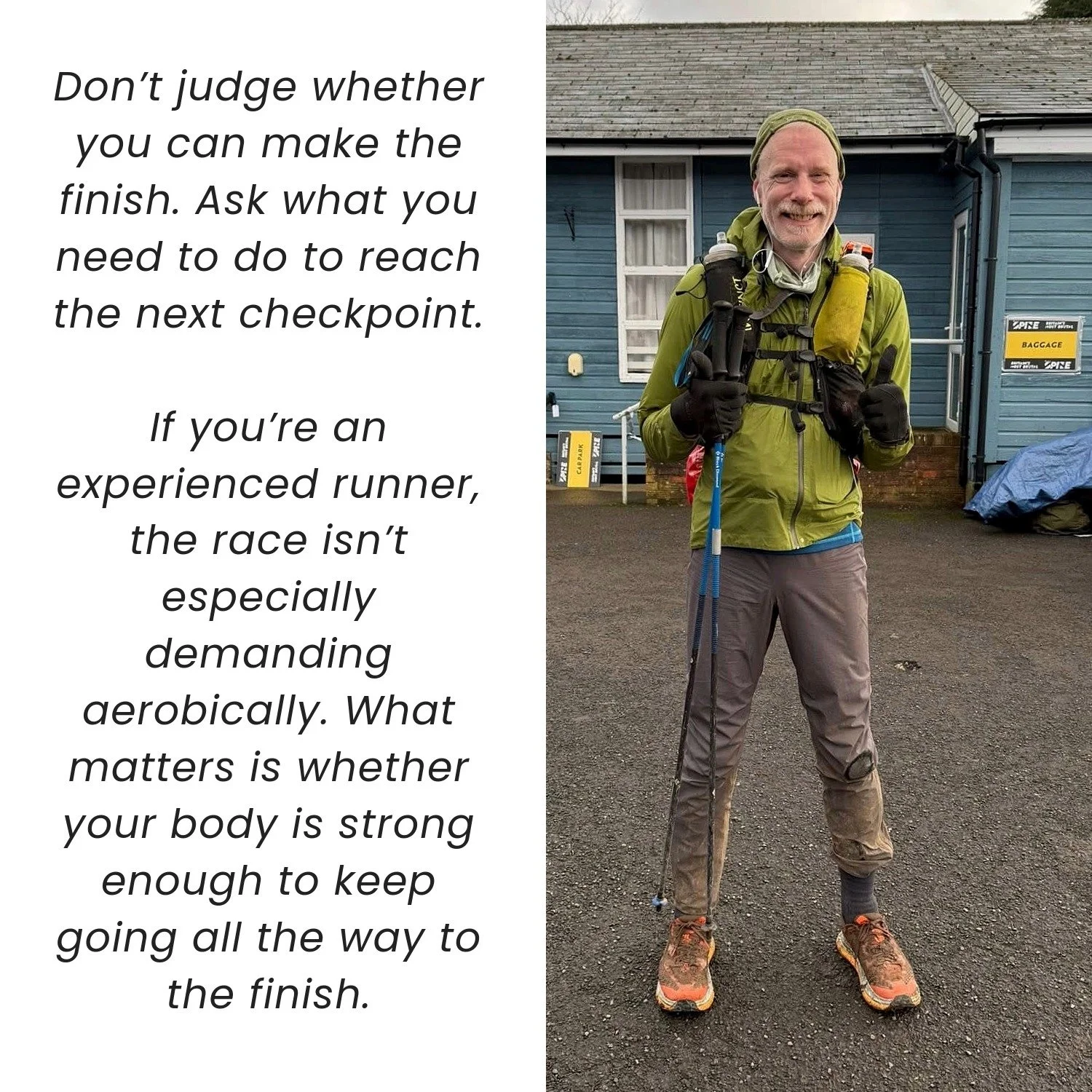
The lesson was simple - don’t judge whether you can make the finish. Ask a much smaller question: ‘Am I well enough to make the next checkpoint without doing long-term damage?’
Do that. Then reassess.
For what it’s worth, the codeine they gave me helped take the edge off the aches and pains too.
7. ‘Here Come the Hotstepper’: Why Strength Training Mattered
I’ll say it now: strength work didn’t make me faster.
But speed isn’t what decides how the Spine goes.
If you’re an experienced runner, the race isn’t especially demanding aerobically. What matters is whether your body is strong enough to keep going all the way to the finish.
I’d had an ankle issue on and off since February and ended up replacing a fair chunk of running with time on the stair stepper, usually carrying a full Spine pack.
That work paid off. I felt strong right to the end, and it never felt like missing those runs cost me anything.
I also knew the race would be hard on feet and ankles, so I did focused strength work there. Even so, I still strained my tib ante.
That might mean I should have done more, or it might just be what happens when you spend days moving through bog, ice, and uneven ground.
Either way, the lesson is simple: the Spine rewards strength and durability far more than aerobic capacity.
8. ‘Decisions, decisions’: What do you want from me?
Whether you articulate it or not, you’re making choices before you even start the race.
Solo or sociable? Sleep when tired or push through? Completion-focused or performance-focused?
Those choices affect pacing, stops, and decision-making. There’s no right answer. But unexamined assumptions cause problems.
I knew going in that I wanted to visit all the classic Spine food stops. I also knew I wanted to push my sleep as far as I reasonably could.
I’d originally had half an eye on placing well, but the ankle injury forced a bit of honesty there.
My strength on the climbs, combined with a slower pace on the flats and descents (thanks, ankle), meant that even when I was around people, I spent a lot of time on my own.
In hindsight, that was exactly what I wanted. A solo experience. The challenge of making decisions myself, in difficult conditions, with no one else to lean on.
I didn’t consciously choose that version of the race at the start. I arrived at it through circumstance and luck.
Learn from me. Make the choice up front. Clarity reduces disappointment.
9. ‘Checkpoints’: Who knows where the time goes
Checkpoints are wonderful places. The volunteers lift your mood, stop you quitting, and generally can’t do enough to help.
They’re also absolute time sinks.
Not because of poor organisation, but because of decision fatigue. When you’re exhausted, trying to charge your headtorch, change clothes, eat, drink, and respond politely to enthusiastic offers of food all at once is surprisingly hard.
Everything feels urgent, and nothing feels simple. Have a checklist. Follow it.
Eat.
Drink.
Change what you need to.
Then reassess.
Your perception of time at a checkpoint is completely unreliable. An hour becomes three without you noticing. You’ve been warned.
In Summary…
There’s often a gap between the race you’ve imagined and the one you actually run.
Hallucinations. Distorted thinking. Sudden certainty about odd ideas. None of this means you’re failing. It means you’re tired.
The Spine isn’t a heroic struggle. It’s a long sequence of ordinary decisions made while cold, fatigued, and slightly under-fuelled.
Get enough of those decisions right, and you keep moving.
So what really helped me?
Knowing where the course is runnable, and where it’s just slow
Eating what I could face, not what looked good on paper
Keeping my feet dry and boring
Having a spare for any single points of failure
Managing layers early - be bothered
Breaking the race into very small pieces
Focusing on strength over aerobic capacity
Being clear about what sort of race I was running
Treating checkpoints as admin, not a holiday
None of this is glamorous - but I hope it’s useful.
If this helps you arrive on the start line a bit better prepared, then it’s done its job.
A Small Bonus
The section titles in this blog are loosely borrowed from song titles. Mostly because I like them.
But also because long races are strange things, and music has a way of attaching itself to moments.
So I’ve put together a slightly tongue-in-cheek playlist that mirrors the themes above. It’s not mandatory kit, but it might make a long training run more interesting. I even listened to some of them during the Spine.